Variable Geometry Brake Disc Ventilation System: Optimizing Cooling and Performance
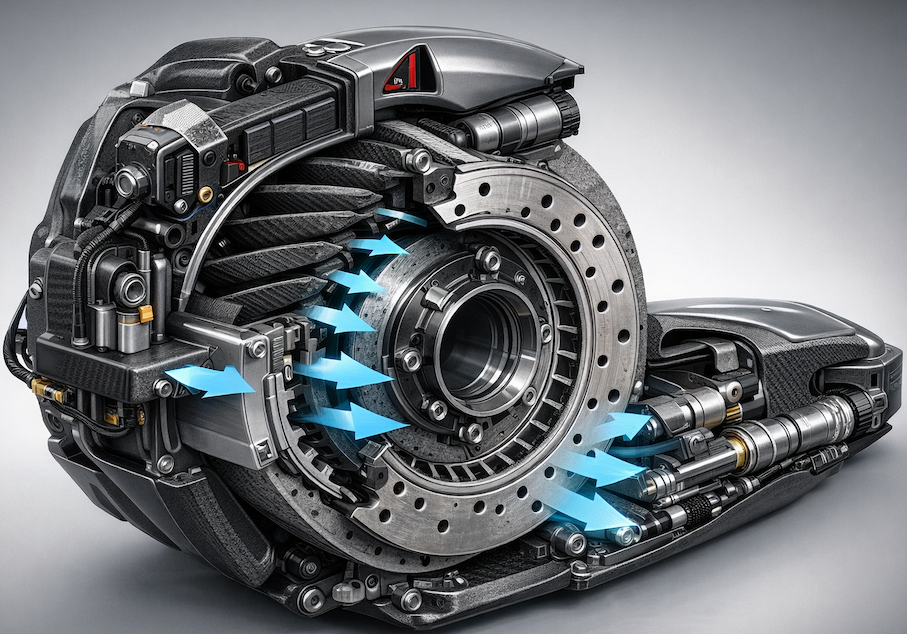
Racing teams continually explore innovative technologies to gain a competitive edge. One such area of intense development is braking system efficiency. The Variable Geometry Brake Disc Ventilation System represents a significant advancement in this domain, offering a dynamic approach to thermal management. This article delves into the engineering principles, regulatory considerations, and performance benefits of this sophisticated system, currently explored under 2026 Formula 1 technical regulations.
The Challenge of Brake Cooling
Braking systems in Formula 1 are subjected to extreme thermal loads. During a Grand Prix, brake discs can reach temperatures exceeding 1000°C. Efficiently dissipating this heat is paramount to prevent brake fade – a dangerous reduction in braking performance due to overheating. Traditional solutions rely on static designs, such as drilled or slotted brake discs and fixed-size brake ducts, to channel cooling air. However, these static systems are a compromise, providing ample cooling during high-demand scenarios but potentially generating unnecessary aerodynamic drag during less demanding phases, such as practice sessions or safety car periods.
The Variable Geometry Solution
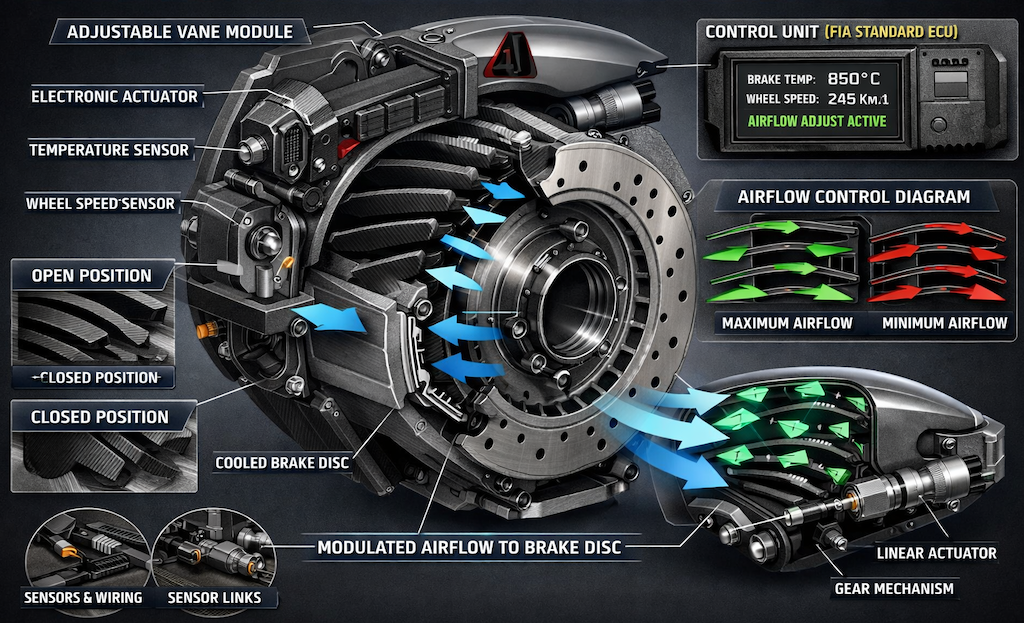
The Variable Geometry Brake Disc Ventilation System introduces an active element to brake cooling. This system comprises adjustable vanes or shutters integrated into the brake caliper housing or dedicated brake ducts. These components are electronically controlled, typically via the FIA Standard ECU as mandated by Article C8.4.1. Real-time data from wheel speed and brake temperature sensors inform the ECU's decisions, allowing the system to dynamically modulate airflow to the brake discs.
The core innovation lies in the adaptive nature of the system. During intense braking zones or high-speed running where thermal loads are significant, the vanes open to maximize airflow, ensuring optimal cooling and preventing overheating. Conversely, during periods of lower demand, such as coasting or low-speed corners, the vanes can adjust to restrict airflow. This not only maintains sufficient cooling but also minimizes the aerodynamic drag typically associated with large brake ducts, contributing to overall vehicle efficiency and potentially improving downforce.
Engineering and Regulatory Considerations
The development of such a system is tightly bound by Formula 1's stringent technical regulations. Key among these is Article C10.2.5, which strictly prohibits any system from adjusting suspension kinematics while the car is in motion. The Variable Geometry Brake Disc Ventilation System is designed with this in mind, ensuring that its actuators solely control airflow and have no mechanical link or influence on the suspension geometry.
Furthermore, all control and actuation systems must comply with the FIA Standard ECU (Article C8.4.1) requirements. This ensures that all operational parameters, adjustments, and sensor data are logged and accessible to the FIA for regulatory compliance and auditing. The system must also adhere to Article C11.3.4, which specifies a minimum cooling hole diameter of 2.5mm for brake discs, ensuring that the modulated airflow is directed through compliant disc designs.
Material selection is another critical aspect. Components must be lightweight yet capable of withstanding extreme operating temperatures and pressures. High-temperature composites and advanced alloys, such as titanium alloys or Inconel, are specified to meet these demanding requirements, often with a safety factor of 1.5 applied to stress calculations.
Operational Benefits and Performance Leverage
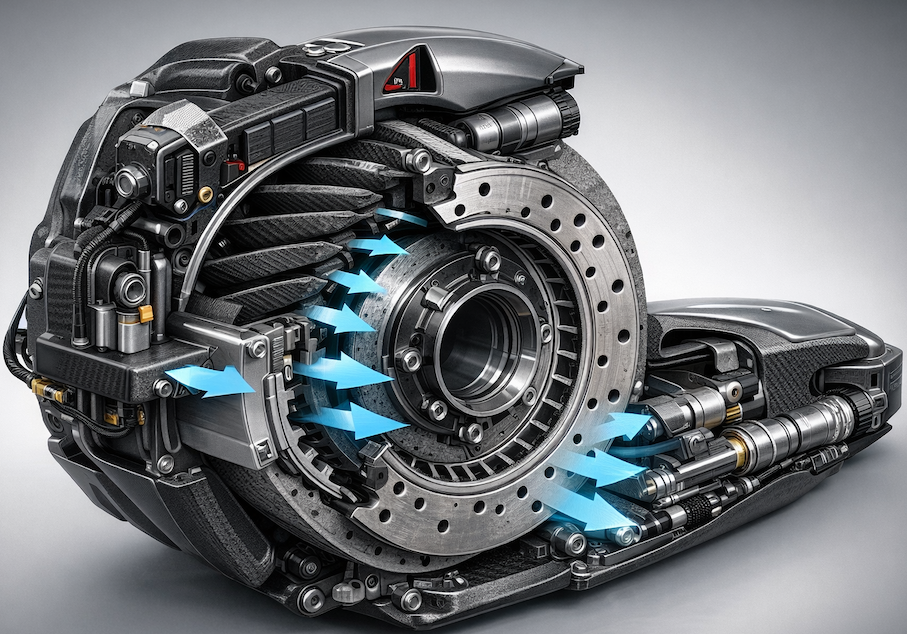
The adaptive cooling provided by the Variable Geometry Brake Disc Ventilation System offers several performance advantages:
Optimized Thermal Management: By precisely controlling airflow, the system ensures brake temperatures remain within their optimal operating window, leading to more consistent braking performance and reduced risk of component failure.
Reduced Aerodynamic Drag: Minimizing unnecessary airflow during lower-demand conditions reduces parasitic drag, potentially improving straight-line speed and fuel efficiency.
Extended Component Life: Consistent operation within ideal temperature ranges can lead to reduced wear on brake discs and pads, extending their service life and reducing the frequency of replacements.
Strategic Flexibility: The ability to tune brake cooling allows teams greater strategic flexibility, particularly in managing thermal loads during different race phases or varying track conditions.
Failure Modes and Mitigation
Despite its sophisticated design, the system is not immune to potential failure modes. These include:
Mechanical Failure: Seizure or fracture of adjustable vanes could lead to a permanently open or closed state. Mitigation involves robust material selection, redundant actuation systems, and fail-safe default positions (e.g., partially open for safe cooling).
Electronic Control Failure: Malfunction of sensors or the ECU could result in incorrect vane positioning. Mitigation includes redundant sensors, cross-checking logic within the ECU, and fail-safe protocols that revert to a safe state (e.g., maximum cooling).
Actuation System Overheating: Components within the actuation system could overheat. Mitigation involves careful thermal management design, including localized cooling and heat shielding, and selecting components rated for the extreme wheel environment.
Aerodynamic Consequences: Unforeseen aerodynamic effects from airflow modulation. Mitigation requires extensive Computational Fluid Dynamics (CFD) analysis and wind tunnel testing to validate performance across all operating states.
Conclusion
The Variable Geometry Brake Disc Ventilation System exemplifies the intricate engineering and regulatory tightrope that Formula 1 teams navigate. By actively managing airflow to the brakes, this hypothetical system offers a compelling pathway to enhanced performance, efficiency, and reliability. Its development and potential implementation underscore the continuous innovation driving the pinnacle of motorsport, where even seemingly subtle improvements in systems like brake cooling can translate into significant competitive advantages, all while operating strictly within the defined boundaries of the FIA's technical regulations.