Unlocking Performance: Our Optimized Suspension Kinematics System
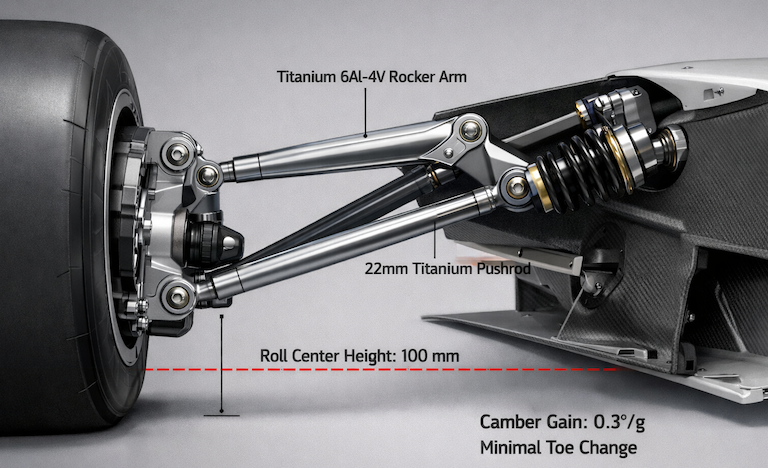
In the relentless pursuit of ultimate on-track performance, every component of an F1 car demands meticulous engineering. Among these, the suspension kinematics system plays a pivotal role, directly influencing mechanical grip, tire management, and aerodynamic stability. Our team has recently finalized the design and initial validation of an Optimized Suspension Kinematics System, a sophisticated solution crafted to maximize the car's potential across diverse racing conditions. This system is a testament to our commitment to innovation, leveraging advanced simulation and material science to push the boundaries of what's possible within the stringent FIA regulatory framework.
The Mandate for Optimization
The primary objective of our new suspension kinematics system is to enhance the interaction between the tires and the track surface. The tire contact patch – the small area where the tire meets the ground – is fundamental to generating grip, both laterally for cornering and longitudinally for acceleration and braking. Any deviation from an optimal contact patch compromises performance. Our design specifically targets crucial kinematic behaviors: camber gain, toe control, and roll center management.
Optimizing these parameters directly contributes to maintaining an ideal tire contact patch throughout the suspension's range of motion. For instance, carefully tuned camber gain ensures that as the car rolls into a corner, the tire camber angle adjusts dynamically to keep the maximum possible rubber on the road, thereby maximizing lateral grip [Article 10.2]. Similarly, precise toe control is essential for stability under braking, preventing unwanted steering inputs and enabling drivers to push harder with confidence [Article 10.2]. Furthermore, the strategic positioning of the roll center height fundamentally influences the car's handling balance and its response to aerodynamic loads.
Our design strictly adheres to FIA technical regulations, notably Article 10.2 concerning sprung suspension and Article 10.4.1 which dictates the use of a single rocker for inboard suspension actuation. These regulations form the bedrock of our compliance strategy, ensuring that our performance gains are achieved within the spirit and letter of the rules [Article 10.4.1].
Engineering the Kinematic Advantage
At the heart of our Optimized Suspension Kinematics System are several key design features and performance parameters that have undergone extensive scrutiny and optimization. We focused on the geometries of the pushrods and rocker arms, alongside the precise placement of pivot points, to achieve the desired kinematic characteristics. Each element has been engineered to contribute to the overall performance envelope of the car.
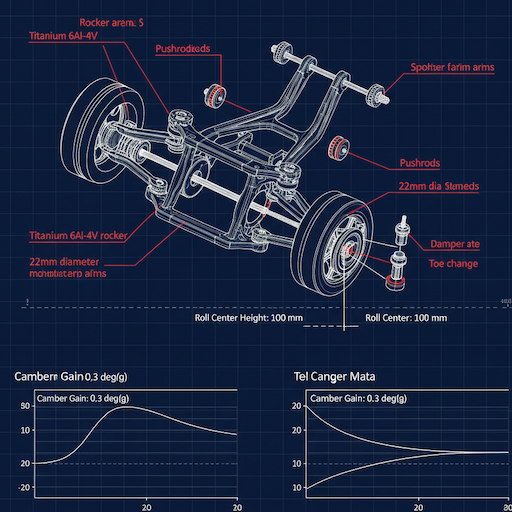
One critical parameter is Camber Gain, defined as the change in camber angle for a given amount of suspension deflection. Our target for camber gain at 1G lateral load is 0.3 degrees per G, with a tight tolerance of ±0.05 degrees/g. This positive camber gain is crucial for maintaining an optimal tire contact patch during aggressive cornering, directly translating to increased mechanical grip and higher cornering speeds. Through advanced CFD simulations and kinematic modeling, we've refined these geometries to achieve this target, ensuring the tire works effectively even at the limit.
Toe Change management is another vital aspect. Under hard braking or acceleration, significant changes in ride height can induce unwanted toe changes, compromising stability. Our system is designed to limit toe change to within ±0.2 mm at 50mm ride height variation. This precise control helps maintain directional stability, especially under heavy braking, allowing the driver to modulate braking forces more effectively without fighting the car.
Roll Center Height is a fundamental parameter that dictates how the car transfers weight during cornering. Our engineers have meticulously positioned the roll center height, targeting a range between 50mm and 150mm from the ground, with a tolerance of ±2mm. This precise control over the roll center allows us to fine-tune the car's handling balance, influencing the distribution of roll stiffness between the front and rear axles and optimizing tire loading during cornering.
Material selection plays an equally critical role in ensuring both performance and durability. For components like the rocker arms and pushrods, we've specified Titanium 6Al-4V. This high-strength, lightweight alloy is manufactured via CNC machining and heat treatment, providing exceptional fatigue life and stiffness, which are paramount given the extreme loads these parts endure. The pushrod diameter, a key determinant of its stiffness and weight, is precisely controlled to be between 15mm and 30mm, with a tolerance of ±0.2mm. Furthermore, we employ spherical bearings for pivotal connections, ensuring minimal friction and accurate kinematic motion throughout the suspension travel.
Finally, ensuring adequate Wheel Travel in both bump and rebound is essential for navigating track irregularities and curbs effectively. Our system is designed to allow a wheel travel of 30-75mm from ride height to full bump and rebound, with a tolerance of ±1mm, providing the necessary compliance without compromising aerodynamic stability. This range allows the suspension to absorb impacts and maintain tire contact without bottoming out or topping out prematurely.
Interfacing for Integrated Performance
The integration of the Optimized Suspension Kinematics System with other critical car systems has been a key consideration from the outset. We focused on seamless interfaces to ensure optimal performance and reliable operation:
- Chassis Mounting Points: The suspension connects to the chassis via inboard pick-up points. The precise location and alignment of these points are paramount for kinematic accuracy, directly influencing how suspension forces are transmitted to the chassis.
- Wheel Upright Attachment: The connection to the wheel upright assembly, typically via ball joints or spherical bearings, is responsible for transmitting suspension movements to the wheel, thereby defining the wheel's kinematics.
- Damper/Spring Interface: The motion ratios at this interface determine how much the damper and spring are compressed or extended for a given wheel travel. This directly influences the car's ride characteristics, requiring careful tuning for optimal performance.
- Anti-Roll Bar Connection: The system interfaces with the anti-roll bar end links or drop links, allowing for precise adjustments to the car's roll stiffness. This adjustability is critical for fine-tuning the car's balance during cornering.
Validation and Testing
Our rigorous validation process ensures that every aspect of the Optimized Suspension Kinematics System performs as designed and complies with all relevant regulations. We subjected the system to a series of engineering tests, focusing on critical performance metrics and regulatory adherence:
- Camber Gain Verification: We accurately measure camber gain at a 1G lateral load to confirm it falls within our specified range of 0.3 ±0.05 degrees/g. This involves high-precision inclinometers and accelerometers, correlated with detailed FEA analysis.
- Toe Change Verification: The toe change at 50mm ride height variation is meticulously measured using laser alignment systems. We ensure this parameter remains within the tight ±0.2 mm tolerance to maintain directional stability.
- Roll Center Height Assessment: The roll center height at both front and rear axles is verified using a dedicated vehicle setup and alignment rig. This ensures the geometric design intent, crucial for handling balance, is precisely met within ±2mm of our nominal design.
- Pushrod Dimensional Compliance: The pushrod diameter is verified through detailed dimensional inspection to be between 15mm and 30mm, with a tolerance of ±0.2 mm. We also confirm the material composition is Titanium 6Al-4V through spectrometry and material certificates [Article 10.2, Article 10.4.1, Article 15.2.4].
- Rocker Arm Material Conformance: We rigorously test and verify that the rocker arm material is indeed Titanium 6Al-4V, confirming its mechanical properties and full compliance with Article 15 of the FIA Technical Regulations [Article 10.2, Article 10.4.1, Article 15.7.1, Article 15.2.4]. This includes specific modulus tests as per FIA Test Procedure 03/03.
- Wheel Travel Inspection: The bump and rebound wheel travel are measured, ensuring they remain within the 30-75mm range from ride height to full bump/rebound, with a tolerance of ±1mm. This ensures adequate suspension compliance under all operating conditions [Article 10.2, Article 10.4.1].
- Inboard Suspension Actuation: Crucially, we verify that the suspension system complies with Article 10.4.1, which mandates that inboard suspension must only be actuated via a single rocker. This is primarily a visual inspection confirmed with CAD models and, if necessary, detailed dimensional measurements.
- Material Compliance (Article 15): A comprehensive material analysis is performed for all suspension components to ensure full adherence to Article 15, which prohibits the use of certain materials like magnesium alloys [Article 15]. This includes material certificates and specific modulus tests.
Conclusion
Our Optimized Suspension Kinematics System represents a significant step forward in our car's performance capabilities. By meticulously controlling critical kinematic parameters such as camber gain, toe behavior, and roll center height, we've engineered a system that maximizes tire contact, enhances mechanical grip, and improves overall handling stability. Our rigorous design, material selection, and validation processes, all conducted within the strict confines of FIA regulations [Article 10.2, Article 10.4.1, Article 15], underscore our commitment to delivering a high-performance, compliant, and reliable solution for the upcoming season. We are confident that this system will empower our drivers to extract every ounce of performance from the car, translating directly into better lap times and improved race results. We look forward to seeing the fruits of this intensive development work on track. Our team remains focused on continuous improvement, always seeking subtle advantages through precise engineering and thorough validation, and this suspension system is a prime example of that philosophy in action.