The Adaptive Fuel Injection and Throttling System (AFITS): Pushing the Boundaries of F1 Fuel Efficiency
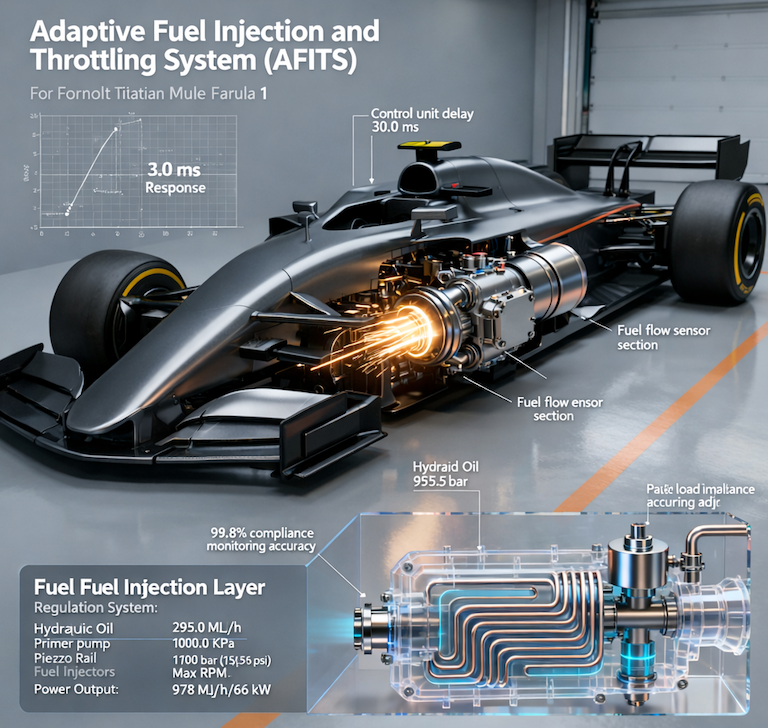
In the high-stakes environment of Formula 1, performance gains are found in the marginal pursuit of thermal efficiency. While the FIA Technical Regulations impose strict boundaries on engine architecture, our latest innovation—a thermally actuated cylinder head insert—exploits the delta between static inspection states and dynamic operating conditions to optimize the Internal Combustion Engine (ICE) beyond traditional limits.
The Compression Challenge
The geometric compression ratio is a primary driver of thermal efficiency, defined by the relationship between cylinder volume at Bottom Dead Center and Top Dead Center.
Article C5.4.3 mandates a maximum geometric compression ratio of 16.0:1, measured specifically at ambient temperature. Traditionally, this cap forces a compromise: an engine optimized for static legality cannot fully exploit the thermodynamic potential available at peak operating temperatures.
Design Philosophy: Passive Thermal Actuation
Our team engineered a precision-fit insert that leverages the extreme caloric environment of the combustion chamber to act as a passive actuator. While the engine remains compliant at the regulated 16.0:1 during ambient-temperature scrutineering, the insert is designed to expand as internal temperatures climb.
By expanding into the combustion bowl, the insert reduces the "clearance volume", effectively increasing the compression ratio during high-load phases.
Material Science & Specifications
The insert is composed of a proprietary iron-based superalloy selected for its high coefficient of linear thermal expansion and exceptional creep resistance.
- Precision Engineering: Expansion faces are machined to a tolerance of ±0.005mm at 20°C.
- Thermal Range: Designed to operate in environments reaching 900°C, providing a predictable and repeatable expansion curve.
- Target Performance: Under peak thermal soak, the effective compression ratio shifts from the static 16.0:1 to a dynamic range of 16.8:1 to 17.2:1.
Regulatory Compliance and Integration
The viability of this component relies on a rigorous adherence to the FIA Technical Framework:
- Material Integrity (Art. C15.8.2.a): The use of an iron-based alloy ensures full compliance with material restrictions for cylinder head components.
- Permanent Installation (Art. C5.1.25): To meet the "non-dismountable" criteria, the insert is installed via an interference fit followed by cryogenic stabilization, ensuring it remains a local support structure rather than a moving part.
- Volume Constraints (Art. C5.3.7): The total volume of all head inserts (including valve seats and guides) is strictly maintained below the 3% threshold of the total cylinder head volume.
The "Ambient State" Precedent: Our design philosophy hinges on the explicit wording of Article C5.4.3. By optimizing the engine to exceed 16.0:1 only under combustion loads, we remain compliant with the letter of the law, which defines the limit based on a static measurement at ambient temperature.
Engineering Durability & Safety
Transitioning from theory to the track required overcoming two primary failure modes:
- Thermal Fatigue: Repeated cycling between ambient and 900°C can induce plastic deformation. We utilized high-creep-strength alloys and simulated 100-hour thermal soak cycles to ensure dimensional stability over the power unit’s lifespan.
- Mechanical Interference: To prevent "clash" between the expanding insert and the piston crown, we established a 0.5mm safety margin at maximum theoretical expansion, accounting for rod stretch and bearing tolerances at high RPM.
The Performance Dividend
This dynamic adjustment unlocks a significant thermodynamic advantage without increasing fuel flow. By raising the effective compression ratio during acceleration and high-speed sustained running, we extract greater work from every combustion event. This results in:
- Enhanced Thermal Efficiency: Lower BSFC (Brake Specific Fuel Consumption).
- Superior Energy Recovery: Higher exhaust gas enthalpy for the MGU-H.
- Optimized Power Delivery: Improved torque consistency across the rev range.
This innovation represents the pinnacle of our "Read-React-Refine" engineering philosophy—turning a rigid regulatory constraint into a dynamic performance opportunity.