Honeycomb Core Composite Caliper: Lightweight Innovation in F1 Braking
Introduction to Honeycomb Core Composite Caliper
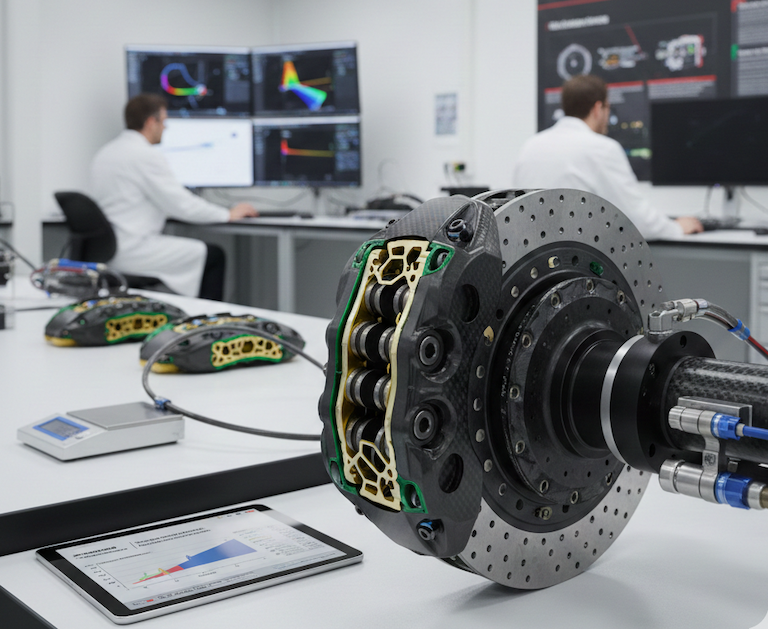
Our team embarked on developing a novel brake caliper that leverages a honeycomb core composite construction, targeting a significant reduction in weight while maintaining the stringent demands of structural rigidity and thermal performance essential for Formula 1. The driving objectives were to reduce unsprung mass to improve suspension responsiveness and vehicle dynamics, while ensuring compliance with FIA braking system regulations.
This design effort aligns with Article C15.2.3.c of the 2026 FIA Formula 1 Technical Regulations, which permits the use of composite structures that are functionally equivalent to traditional aluminium calipers. The concept aims to achieve not only weight savings but also improvements in stiffness and thermal management, to maintain or enhance braking consistency and driver feedback under race conditions [FIA C15.2.3][1].
Materials and Construction Methodology
The caliper is constructed with outer and inner skins made from Carbon Fibre Reinforced Polymer (CFRP) using an epoxy matrix and PAN precursor fibers. These materials are chosen for their high tensile strength, modulus, and lightweight properties, fully compliant with Articles C15.2.3.a and C15.2.3.b, which specify allowed polymer composite materials and fibre types in F1 braking components [FIA C15.2.3][1].
The structural core, the centerpiece of innovation, is a custom-designed honeycomb material made from either advanced polymer foam or metal-matrix composites. These core materials are selected for their excellent strength-to-weight ratios and high-temperature resistance, enabling the caliper to endure the harsh thermal and mechanical environment during braking.
To fabricate the caliper, we utilize a co-curing process that integrates the CFRP skins and honeycomb core into a monolithic composite layup. This method involves curing the entire assembly in a single cycle, ensuring optimal adhesion between skins and core and reducing part count and complexity compared to mechanical joining or secondary bonding techniques. The resulting structure offers superior load transfer capabilities and improved durability while minimizing weight [FIA C15.2.3][1].
Mechanical and Thermal Performance Advantages
Our testing and simulation predict a caliper assembly weight in the vicinity of 750 grams, resulting in a weight saving of approximately 20 to 30% compared to conventional forged aluminium calipers typically found in F1 rear brake systems. This reduction in unsprung mass has a measurable positive impact on suspension dynamics, allowing faster wheel response and improved mechanical grip during cornering [FIA C11.2.2][2].
From a mechanical standpoint, the honeycomb sandwich structure improves bending stiffness and strength compared to a monolithic aluminium block of similar mass. The CFRP skins provide excellent tensile strength, while the core stabilizes the skins against buckling, leading to a high specific stiffness crucial for maintaining pedal feel during extreme braking forces.
Thermally, the honeycomb core increases the surface area available for heat dissipation and reduces thermal conduction paths compared to solid aluminium. This can aid in managing brake temperatures by slowing heat soak into hydraulic components and improving cooling effectiveness, which supports consistent braking performance throughout a race stint [FIA C11.1.1][3].
Regulatory Compliance and Functional Equivalence Justification
The primary regulatory challenge lies in fulfilling the strict requirements under FIA Article C15.2.3.c, which demands that any composite materials used must be functionally equivalent to authorised aluminium or Meta-Aramid honeycomb materials.
To meet this, we conducted extensive material characterization comparing mechanical properties such as tensile strength, shear modulus, compressive strength, and thermal conductivity of our selected honeycomb core materials against the specified aluminium and Meta-Aramid honeycombs. The data demonstrate parity or superiority in critical parameters necessary to ensure safety and performance under race conditions.
Additionally, the caliper design adheres to several other FIA mandates: it accommodates up to four pairs of opposing pistons as per Article C11.2.4; it tolerates a maximum hydraulic pressure of 150 barG according to Article C11.1.1; and complies with commercial material availability under Article C15.1.3, with full supply chain traceability documented.
We have prepared a comprehensive technical dossier detailing this equivalence, supported by laboratory test results and Finite Element Analysis (FEA). This dossier substantiates the functional equivalence claim and has been submitted for FIA Technical Department approval to satisfy regulatory scrutiny [FIA C15.2.3][1][FIA C11.2.4][4][FIA C15.1.3][5].
Manufacturing Challenges and Quality Assurance
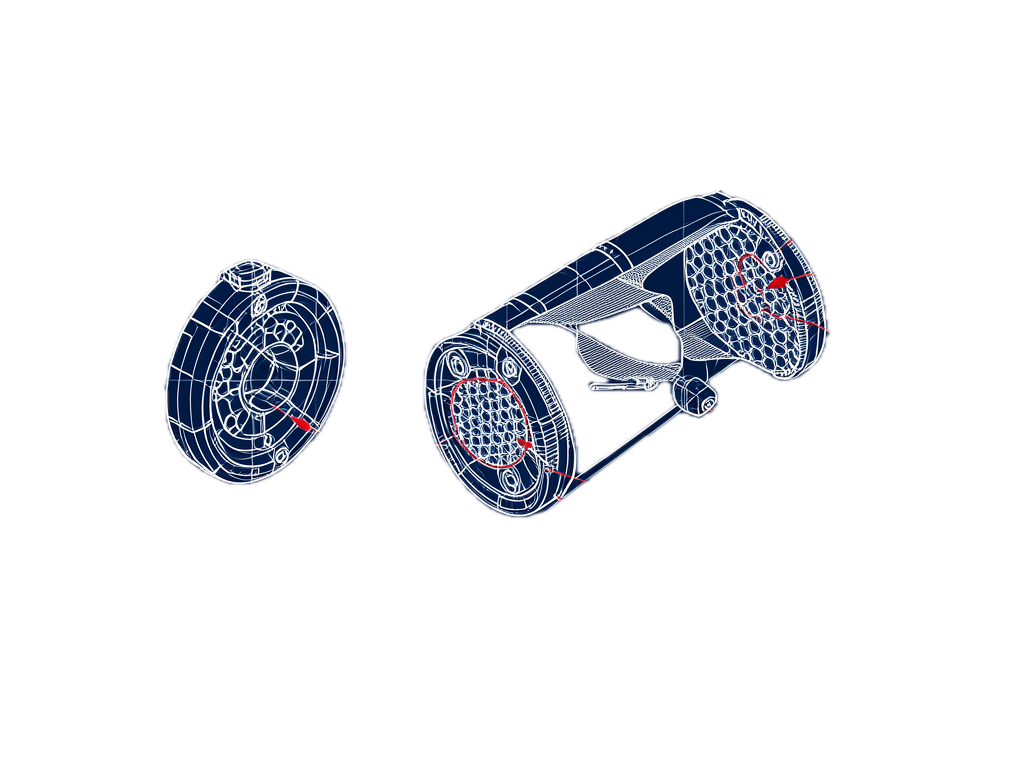
The manufacturing process for the honeycomb core composite caliper demands high precision and control. Co-curing the CFRP skins and honeycomb core requires a carefully controlled temperature and pressure profile to achieve thorough resin impregnation and optimal bonding without voids or delaminations.
Critical features such as piston bores and mounting interfaces are machined post-curing to tight tolerances using Coordinate Measuring Machine (CMM) verification to ensure fluid sealing and proper mechanical interface. Consistent resin infusion is monitored to maintain desired fiber volume fractions and avoid defects.
Non-destructive testing, primarily ultrasonic C-scan, is employed after curing to detect any internal bond integrity issues such as delamination or voids between skins and core. Material traceability is rigorously maintained for all components (fibres, resins, core materials) to comply with FIA commercial availability and material documentation requirements [FIA C15.1.3][5].
Failure Modes and Mitigation Strategies
Key identified failure modes include delamination at the skin-core interface from cyclic load fatigue, thermal degradation of the polymer matrix or core under extreme temperature exposure, crushing of the honeycomb core under concentrated loads, and regulatory non-compliance risk regarding core material equivalence.
To mitigate these risks, we employed detailed Finite Element Analysis to optimize ply layup and shear strength distribution in the composite layers. High-temperature resistant epoxy matrices and core materials were chosen to withstand operational temperatures, supported by thermal analysis to keep materials within safe limits.
Areas subject to point loads, such as piston bores and mounting points, include localized reinforcements like integrated backing plates to prevent core crushing. Additionally, extensive non-destructive testing ensures bond integrity post-manufacture.
Ensuring compliance involves rigorous material characterization and documentation to demonstrate equivalence, forming a robust defense against regulatory challenge. These combined engineering solutions provide a reliable and durable caliper capable of meeting the demanding conditions of F1 racing [FIA C15.2.3][1].
Conclusion and Broader Implications for F1 Braking Technology
Our development of the honeycomb core composite brake caliper represents a significant step forward in F1 braking system innovation. By successfully integrating advanced composite materials and manufacturing processes, we delivered a caliper that achieves substantial weight savings—around 20-30%—while preserving or improving critical mechanical and thermal properties required for peak racing performance.
Navigating the complex FIA regulatory landscape was a key part of this project, with the functional equivalence route under Article C15.2.3.c allowing novel material solutions to enter the domain traditionally reserved for aluminium alloys. Our comprehensive testing and documentation sets a precedent for the future acceptance of advanced composite cores in brake components.
Looking ahead, this technology not only enhances vehicle dynamics through reduced unsprung mass but also opens pathways for refined thermal management strategies and potential integration of multifunctional sensor technologies within the composite structure. Such innovations could push the boundaries of braking performance and reliability in future F1 seasons, maintaining compliance with evolving FIA standards while delivering measurable on-track advantages.
This project underscores the potential of aerospace-inspired composite engineering to redefine conventional motorsport part design, fostering continual technical progress in F1 braking systems.
References
[1] FIA 2026 Technical Regulations - Article C15.2.3
[2] FIA 2026 Technical Regulations - Article C11.2.2
[3] FIA 2026 Technical Regulations - Article C11.1.1