Dynamic Breathing: The Art of Variable Geometry Intake Trumpets
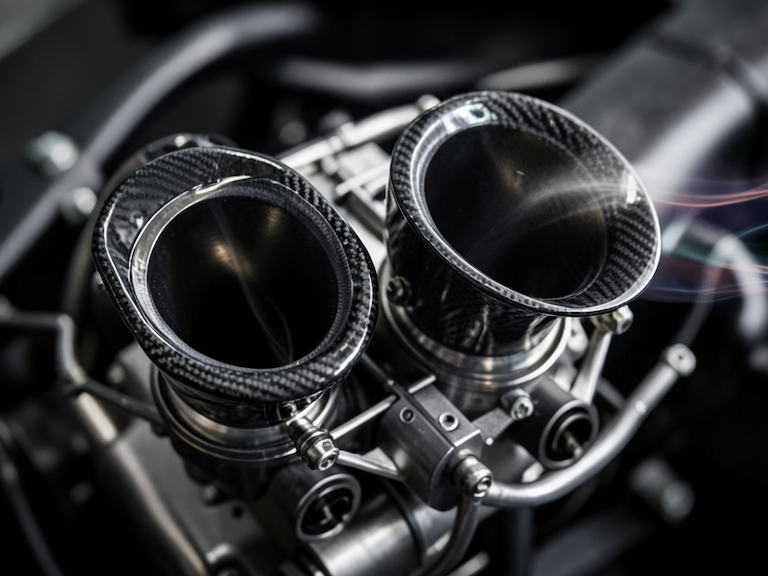
At the forefront of F1 Power Unit development, our team has integrated a sophisticated Variable Geometry Intake (VGI) Trumpet system designed to push the boundaries of engine performance. This innovation represents a leap forward in optimizing air management for the demanding and varied conditions of Formula 1 racing. We will delve into the design, materials, and regulatory compliance that make this innovation possible.
The core objective of variable geometry intake trumpets is to maximize volumetric efficiency across the engine's entire RPM range. Volumetric efficiency, for the F1 enthusiast, refers to how effectively an engine can fill its cylinders with air-fuel mixture. In a fixed-geometry system, the intake tract length is a compromise, optimized for a narrow RPM band. Short intake runners generally favor high RPM power by reducing restriction and allowing faster airflow, while long runners enhance low-to-mid range torque by leveraging resonant wave tuning. Our VGI system, with its dynamically adjustable trumpets, eliminates this compromise.
We've engineered two primary trumpets, each featuring variable length and profile mechanisms. This dynamic adjustment allows for real-time fine-tuning of air velocity and density as it enters the combustion chamber. By precisely managing the intake air's kinetic energy, the system ensures maximum cylinder filling, leading to increased power output and torque across the entire operational spectrum of the engine. This offers a significant performance advantage over traditional fixed-geometry intake systems.
Precision Engineering and Materials
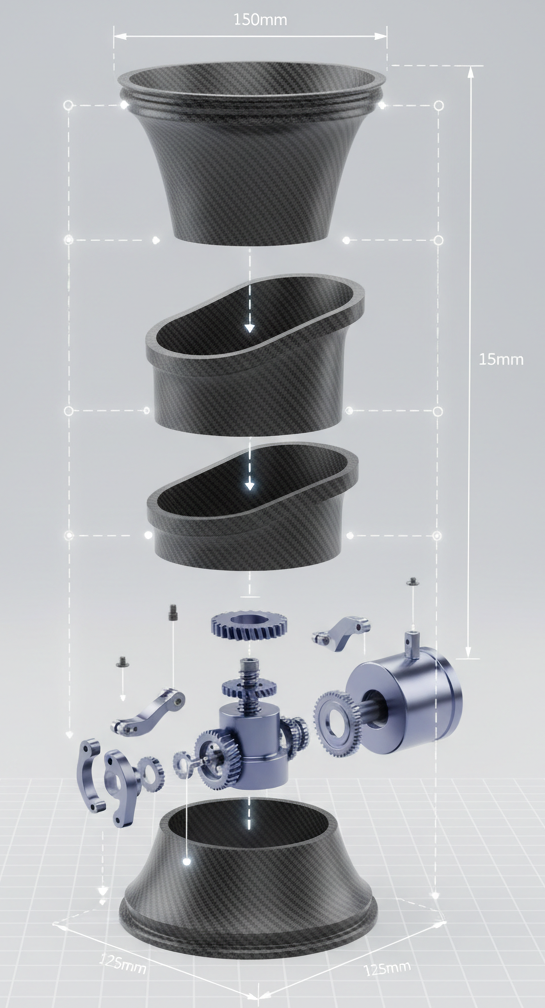
The construction of these trumpets demands extreme precision and advanced materials. For the trumpet bodies, we primarily utilise carbon fiber prepreg (T1000) for its exceptional strength-to-weight ratio and stiffness. In some specific high-stress applications, titanium alloy (Grade 5) is also employed. These materials, along with those for actuator components such as titanium alloy (Grade 5) or aluminum (7075), undergo rigorous FIA material testing and certification, as mandated by [Article C15.1.8]. The precise geometric tolerances, often within hundredths of a millimeter, are achieved through high-precision CNC machining.
The integrated actuation system is the brain behind the dynamic adjustments. It employs advanced kinematic mechanisms and lightweight, high-strength actuators. Our engineers focused on designing an actuation system that ensures rapid and accurate profile changes, crucial for seamless performance adaptation. The maximum travel distance of the actuator is meticulously controlled, typically ranging from 0.2mm to 1.5mm, enabling a comprehensive range of dynamic adjustments. This system, designed for reliability and durability, must withstand the intense competitive race conditions and adhere to strict homologation (the process of certifying compliance with regulations) requirements. The entire system integrates with the FIA standard ECU for control and data logging, ensuring seamless operation and adherence to performance monitoring guidelines without violating [Article C8.4.1] concerning unauthorized software or external control systems.
Regulatory Compliance: Threading the Needle
Developing such an advanced system in Formula 1 requires strict adherence to the FIA Technical Regulations. Our Variable Geometry Intake Trumpets are designed with specific articles in mind, ensuring legality and fair play.
Firstly, the physical dimensions and location of the air inlets are tightly controlled. The regulations stipulate a maximum of two air inlets, which must be situated on a single X-plane between XC=-850 and XC=-500, and fully visible from the front of the car [Article C5.6.1]. Our design meticulously adheres to these constraints, ensuring the system remains within the prescribed envelope while maximizing airflow capture.
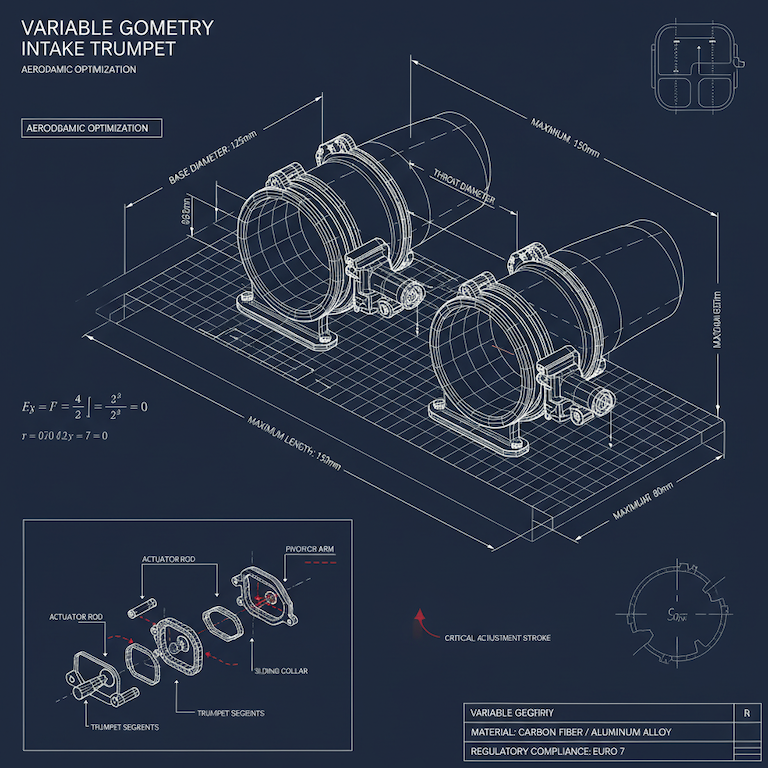
Beyond physical location, the air itself is regulated. Engine intake air pressure must remain below 4.8 barA at all times, a critical safety and performance parameter, verified through FIA-approved and sealed devices [Article C5.3.2]. Furthermore, to prevent any form of charge air cooling, the intake air temperature must maintain at least 10°C above ambient temperature, with lap average measurements confirmed by FIA-approved sensors [Article C5.13.8].
Another significant challenge addressed during development involves the plenum definition. Article [Article C5.6.4] sets limits on the surface area of any component forming a volume within the intake system (10000mm² per bank or 3400mm² per cylinder supplied). This regulation prevents teams from gaining an unfair advantage through excessively large or strategically shaped plenums that could act as performance enhancers. Our design prioritizes minimizing internal volume and surface area within the intake system, aligning with the objective of enhancing air velocity and density without inadvertently creating an "Engine Plenum" as defined by the regulations.
Overcoming Development Challenges
One of the significant hurdles we encountered was integrating the intricate actuation mechanism within the incredibly confined space of an F1 Power Unit. Miniaturization, while maintaining robust performance without adding excessive mass (the actuator mass is between 10kg and 25kg inclusive of linkages), required extensive iterative design and simulation. We overcame this by developing novel, compact kinematic solutions and leveraging advanced manufacturing techniques to produce incredibly small yet durable components. This ensured the system could reliably achieve its specified 3 to 5 discrete geometric configurations, crucial for optimal performance, without compromising packaging efficiency or introducing reliability concerns such as material fatigue or fracture under dynamic loads.
Conclusion
The Variable Geometry Intake Trumpets represent a testament to cutting-edge F1 engineering, blending aerodynamic mastery with regulatory compliance. By dynamically optimizing air induction, we unlock greater power and efficiency across the entire engine operating range. This system is a vital component in our relentless pursuit of performance, meticulously crafted to deliver a competitive edge while adhering to the exacting standards of Formula 1.