Ceramic-Enhanced Thermoset Calipers: Engineering a 2026 Regulatory Solution
Introduction to Brake Caliper Material Innovations
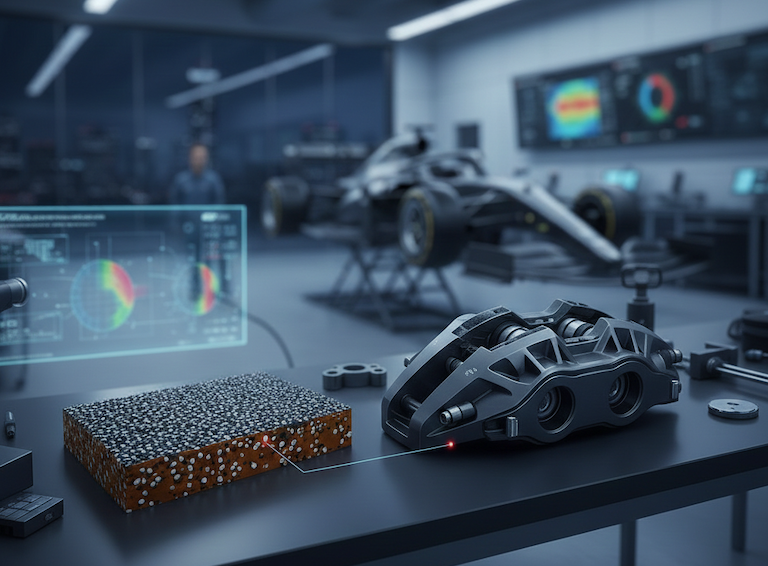
In response to the evolving 2026 FIA braking system regulations, our engineering team faced an intriguing challenge: how to innovate within the constraints mandating brake calipers to be constructed primarily from aluminium materials (Article C11.2.2) while leveraging the allowance for particulate-filled thermoset polymers as interpreted from Article C15.2.4. This interpretation provided a pathway to explore advanced composite materials that could deliver superior performance metrics.
Our team developed a thermoset caliper body reinforced with advanced ceramic particulates, namely Silicon Carbide (SiC) and Boron Nitride (BN), embedded within a high-temperature epoxy resin matrix. This approach not only complies with the commercial availability requirement (Article C15.1.3) but also significantly addresses critical performance areas such as mass reduction and thermal management. By innovating beyond traditional solid aluminium calipers, we aimed to reduce unsprung weight and improve heat dissipation to mitigate brake fade under race conditions.
Material Composition and Thermal Management Advances
Our caliper design centers around a sophisticated particulate-filled thermoset composite, combining the epoxy resin matrix with a precise volumetric loading of silicon carbide and boron nitride particulates. Silicon Carbide is chosen for its high thermal conductivity and mechanical robustness, whereas Boron Nitride enhances thermal conductivity and provides excellent lubricity, aiding heat transfer and structural resilience.
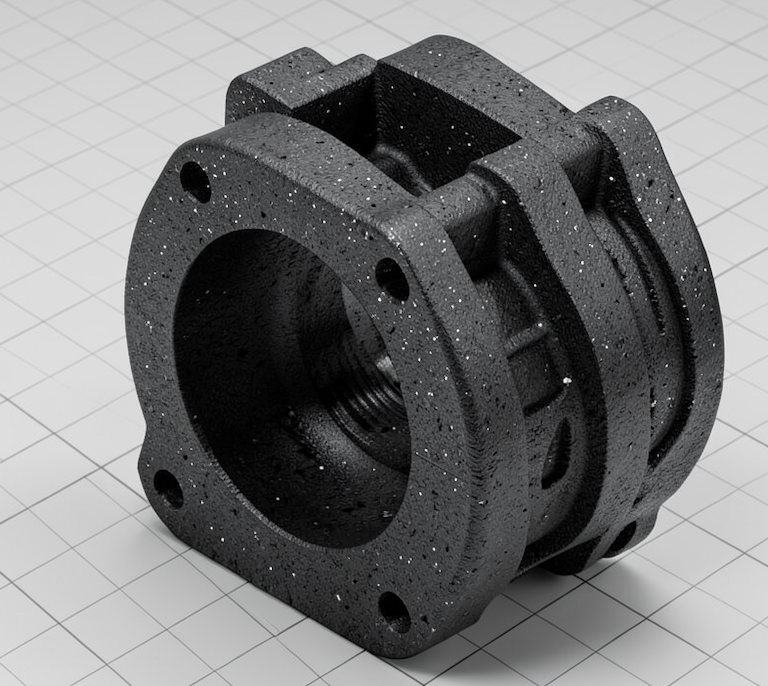
Achieving an optimal filler volume fraction between 35% and 50% (set nominally at 40%) was crucial. This balance ensures that the composite attains a thermal conductivity substantially higher than standard aluminium alloys while maintaining mechanical integrity. Unlike aluminium 6061-T6, our caliper material does not merely rely on conduction through a metallic lattice but benefits from the synergistic interaction of the ceramic fillers and the thermoset matrix, which results in improved heat dissipation performance—validated by our internal thermal analysis showing a significant enhancement in heat transfer efficiency during simulated braking cycles.
Our engineers meticulously controlled the particulate size distribution around 10 microns, ensuring homogeneous dispersion to avoid agglomeration which could lead to localized thermal or mechanical stresses. This uniformity was critical not only for thermal performance but also for reliability when exposed to the extreme cyclical thermal loads typical in a Grand Prix race. The epoxy resin system was chosen based on its high glass transition temperature and resistance to thermal degradation, complementing the ceramic fillers to maintain performance stability at elevated temperatures.
Mechanical Design and Regulatory Compliance
The mechanical architecture of our caliper was engineered to comply rigorously with FIA specifications. We designed the caliper with two pairs of opposing pistons, consistent with limits imposed by Article C11.2.4. Maintaining precise control over the caliper body dimensions was paramount. The body width was maintained within 75mm to 85mm, and height not exceeding 150mm to 180mm, adhering to the maximum dimensional criteria enforced by regulations to ensure compatibility with wheel assemblies and aerodynamic packaging.
Our material selection demanded wall thicknesses exceeding the minimum 2.5mm to 3.5mm to assure structural integrity under hydraulic pressure loads up to 150 barG (Article C11.1.1). Unlike aluminium, composite materials require greater care in stress distribution, so we utilized extensive Finite Element Analysis (FEA) to optimize wall thickness and particulate orientation for load-bearing sections, minimizing the risk of fatigue or cracking. Additionally, we applied advanced machining tolerances to the internal bore surfaces, achieving surface finishes better than Ra 0.8 µm, critical for precision seal fitting and preventing brake fluid leakage.
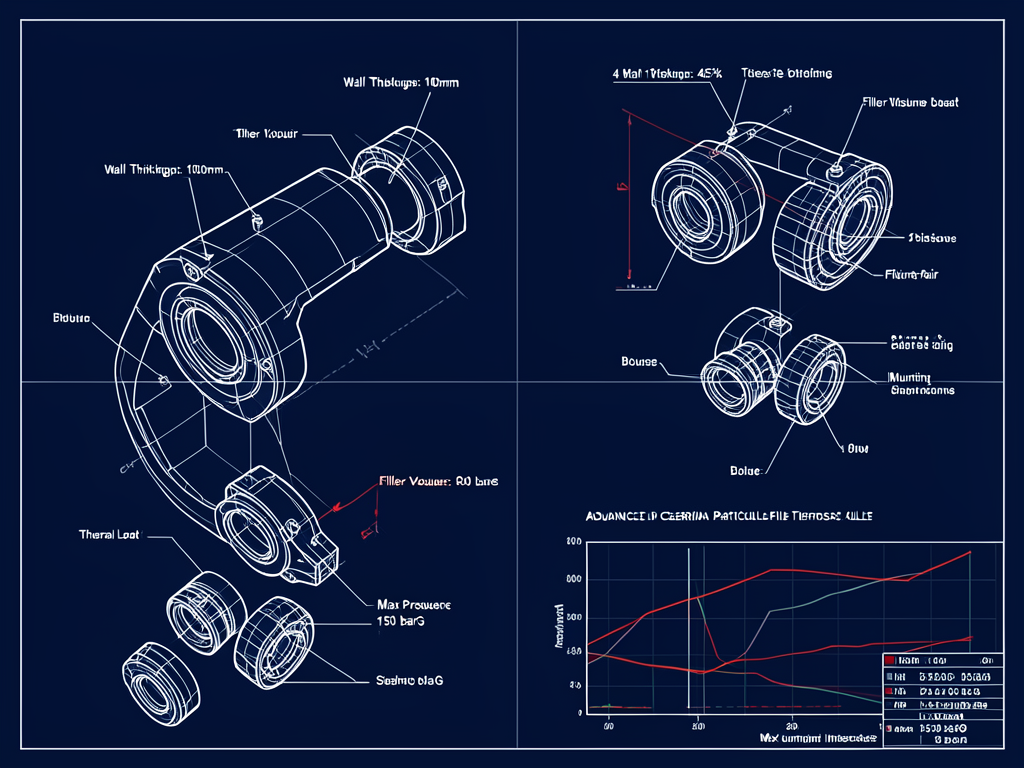
Throughout the design phase, our team rigorously cross-referenced critical regulatory articles governing materials, piston counts, and dimension limits to ensure compliance. This included thorough review of interpretation guidelines regarding particulate-filled thermoset composites that are recognized as equivalent alternatives to aluminium brake calipers.
Manufacturing Techniques and Quality Assurance
Processing our ceramic particulate-filled thermoset composite demanded specialized manufacturing techniques. Precision machining employed diamond tooling to circumvent delamination risks and maintain edge integrity. Controlled cutting speeds and feed rates were essential to mitigate heat build-up and mechanical stresses during machining.
Curing protocols for the epoxy matrix were tightly controlled following resin supplier guidelines to optimize polymer cross-linking and thermal resistance. Cure cycles involved gradual ramp-up of temperature, steady holds around peak temperature, and slow cooling to prevent thermal shock and ensure dimensional stability.
Post-machining, our quality assurance processes incorporated ultrasonic non-destructive testing (NDT) to detect any internal voids, resin-filler delamination, or cracks that might compromise caliper safety. We also performed image analysis on cross-sectional samples to verify ceramic particulate distribution and volume fraction adherence. Surface profilometry confirmed bore finish tolerances, while dimensional inspections utilized coordinate measuring machines (CMM) for external features.
Such rigorous validation steps were pivotal in assuring our caliper met the high reliability standards mandatory for competition-grade braking components.
Failure Modes and Mitigation Strategies
Brake calipers face intense operating conditions, so understanding potential failure modes was integral to our development process. One primary risk is thermal runaway: excessive heat accumulation could vaporize brake fluid, causing sudden loss of braking performance. We mitigated this by optimizing particulate loading to maximize thermal conductivity, incorporating integrated cooling passages within the caliper design, and leveraging materials with high thermal stability.
Mechanical fatigue and cracking posed another challenge due to cyclic loading stresses. Our design addressed this risk through comprehensive FEA to identify and reduce stress concentrations, alongside orienting the ceramic fillers strategically within the resin matrix to enhance toughness. Rigorous fatigue testing cycles validated these approaches.
Seal extrusion or leakage, often caused by thermal expansion differentials or surface imperfections on piston bores, was minimized by precision machining to achieve smooth surfaces and strict tolerance control on piston-bore clearances. High-temperature resistant seals were selected to maintain sealing performance throughout thermal excursions.
Our combined strategy balances thermal, mechanical, and hydraulic reliability, ensuring the caliper withstands the demanding race environment.
Integration Interfaces and System-Level Considerations
Our caliper design integrates seamlessly within the broader braking system architecture. The upright mounting uses M10 high-tensile steel bolts with defined torque settings to ensure secure attachment while accommodating the dynamic loads during braking transients.
Hydraulically, the brake fluid inlet conforms to standardized AN fittings, facilitating reliable and leak-proof brake line connections. The piston faces are engineered for optimal engagement with brake pad backing plates, ensuring consistent pad actuation and load distribution.
Importantly, the caliper incorporates mounting points for brake-by-wire sensors compliant with regulatory requirements (Article C11.6). This enables advanced braking control strategies and telemetry, enhancing feedback on piston position and brake pressure to the team and driver.
Our system-level design approach ensures the caliper contributes effectively to the overall vehicle braking performance, balancing mechanical efficiency with regulatory compliance and enabling advanced technologies in line with the 2026 regulations.
This advanced ceramic particulate-filled thermoset caliper represents an exciting blend of regulatory interpretation, material science innovation, and precision engineering by our team. Embracing composite solutions within FIA constraints allowed us to push thermal and mechanical boundaries to produce a brake caliper that enhances race performance reliability and vehicle dynamics in the 2026 Formula 1 season.
References
- Article C11.2.2: FIA 2026 Technical Regulations - Article C11.2.2
- Article C15.2.4: FIA 2026 Technical Regulations - Article C15.2.4
- Article C15.1.3: FIA 2026 Technical Regulations - Article C15.1.3
- Article C11.2.4: FIA 2026 Technical Regulations - Article C11.2.4
- Article C11.1.1: FIA 2026 Technical Regulations - Article C11.1.1
- Article C11.6: FIA 2026 Technical Regulations - Article C11.6